Kara’s research interests include the geographies of food systems, measures of access, public assistance programs, and applications of geovisualization in evaluation and program planning.
RESEARCH & VISUALIZATION
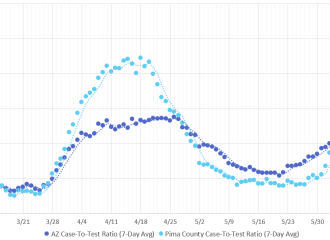
COVID-19 Visualization
This project visualizes key metrics on COVID-19 in Pima County & Arizona to highlight trends in the spread of COVID-19 in the region.
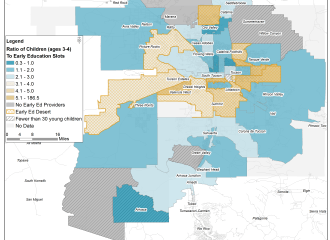
Child Care & Early Education Accessibility in Tucson
This white paper, funded by the Making Action Possible for Southern Arizona (MAP) Dashboard, identifies and maps child care deserts in the greater Tucson area, and describes the sociodemographic characteristics of these local areas that have limited access to child care. Given the importance of quality in early care and education settings, we additionally identify…
Read more Child Care & Early Education Accessibility in Tucson
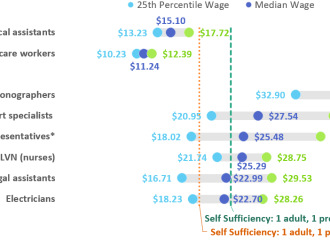
Women’s Work: Realities and Possibilities for Arizona
Across Arizona, full-time working women are most commonly employed in human service fields, such as nurses, medical assistants and teachers, and in administrative, customer service and retail positions. Although vital to the economy, many of these jobs may not provide adequate income for women, especially single mothers of young children, to support their families. Even…
Read more Women’s Work: Realities and Possibilities for Arizona
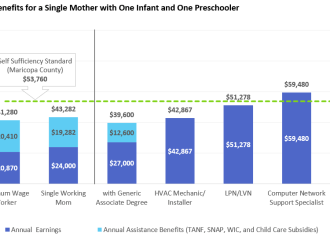
Relationship of Economic Independence and Access to Childcare for Single Moms
Many Arizona families, particularly single mothers with young children, face substantial challenges in meeting their economic needs. Almost one in three (29%) children under age six in the state lives in poverty, putting them at risk for a host of future economic, health, and social concerns. Currently, the vast majority of Arizona low-income single mothers…
Read more Relationship of Economic Independence and Access to Childcare for Single Moms
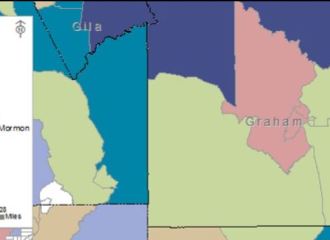
RIDGE Rurality and Food Access Project
Much of the current study of the challenges in health, nutrition, and food security faced by people in rural areas fails to consider the often substantial differences in needs and barriers across rural communities. This project analyzed social, economic, and geographic community features to attempt to characterize rural areas in Arizona.
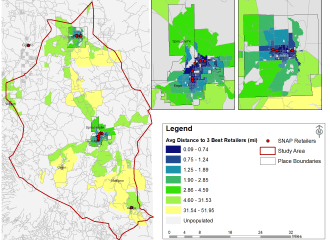
Food in Reach: Measuring Access to Public Assistance Food Retailers in Rural Arizona
Through using a grounded mixed-methods approach, I hope to integrate quantitative measures of access derived from retailer locations and road networks with qualitative insight from participant interviews into individual intentions and lived experience using public assistance benefits to shop for food. An access map showing the relative accessibility of retailers accepting SNAP benefits will be compared and contrasted with individual experiences using SNAP benefits in rural communities.
Read more Food in Reach: Measuring Access to Public Assistance Food Retailers in Rural Arizona
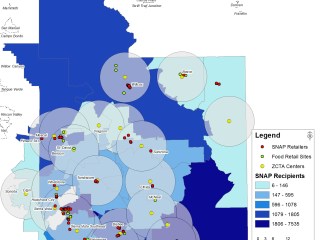
Location Modeling for SNAP Retailer Recruitment
The purposes of this project are threefold: (1) assess how the current distribution of SNAP and WIC retail locations compares to an optimal distribution of retail locations, (2) identify optimal sites for convenience store outreach to reach the highest number of SNAP enrollees, (3) identify key grocery stores for retention in the WIC program. Through this pilot study, I demonstrate the potential utility of simple location models for the baseline study of the food system in Arizona and the planning of future programming in line with the new Policy, System, and Environment (PSE) approaches.
 Kara Haberstock Tanoue